
New: Advancing Serious Illness: How Words Can Help or Hinder Needed Actions
By Jeff Cohn, MD, MHCM, Common Practice Medical Director
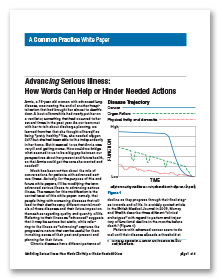
People living with worsening diseases that will lead to their deaths carry different mental models of those diseases and their future impact on themselves regarding quality and quantity of life. This white paper introduces three common patterns of decline – advanced cancer; organ failure; and physical frailty and dementia – and explores the types of end of life conversations that people in each archetype would benefit from along with guidance on initiating these conversations.
Click here to download this white paper
Multiple Goals: a Framework for Understanding and Improving Quality in End of Life Communication
By Nick Jehlen, Common Practice Partner
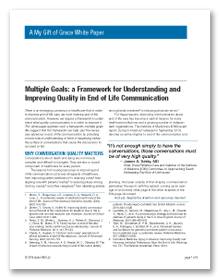
In order to improve end of life care, we must improve end of life communication. However, we require a framework to understand what quality communication is in order to improve it. This white paper explores such a framework: multiple goals. We suggest that this framework can help spur the necessary advances in end of life communication by providing a more robust understanding of what is happening below the surface in conversations that cause the discussions to succeed or fail.
Click here to download this white paper
Accommodation: When communicating about end of life issues, it matters how people speak
By Nick Jehlen, Common Practice Partner
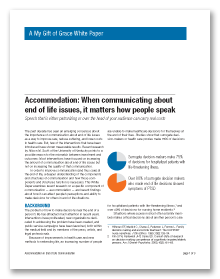
While there is an emerging consensus that quality communication is vital to improving care at the end of life, the question of what constitutes quality in this context has not received much attention. This white paper introduces research by University of Kentucky professor Allison M. Scott on one important component of quality in end of life communication: over- and underaccommodation.
Click here to download this white paper